A lively debate...enjoy :)
Wednesday, June 25, 2008

Wednesday, June 18, 2008
Venezuela's Currency Plummets
Here is an article I found about the currency in Venezuela due to changes by Hugo Chavez. My sister actually just recently got back from Venezuela and when I told her about Hugo Chavez she told me her experience. In attempt to make the Venezuelan currency worth more compared to foreign currency, he cut the overall worth of the Venezuelan currency in half. For instance, if the Venezuelan currency was 10:1 dollar, it is now 5:1 dollar, making it worth more in the eyes of tourists. The problem with this is not only did Chavez cut the worth of the currency but also the worth of all the Venezuelan citizen's possessions. According to my sister, as a tourist she was advised not to exchange her dollars through the bank but through the black market currency. This is where most people exchange their money.
Overall, I was a little concerned about this issue because I had the idea that Hugo Chavez was great, but as I studied more on the issue, I'm a little split. What do you guys think? Here's one article based solely on the currency and also another one about the other side to his story.
Article 1:
http://www.foreignaffairs.org/20080301faessay87205/francisco-rodriguez/an-empty-revolution.html
By Alex Kennedy and Matthew Walter Bloomberg News
Published: September 3, 2007
CARACAS: The Venezuelan economy, under the direction of President Hugo Chávez, is starting to unravel in the currency market.
While Venezuela earns record proceeds from oil exports, consumers face shortages of meat, flour and cooking oil. Annual inflation has risen to 16 percent, the highest in Latin America, as Chávez tripled government spending in four years.
Exxon Mobil and ConocoPhillips are pulling out after Chávez demanded that they cede control of joint venture projects.
The bolivar has tumbled 30 percent this year to 4,850 per dollar on the black market, the only place it trades freely because of government controls on foreign exchange. That compares with the official rate of 2,150 per dollar set in 2005. Chávez may have to devalue the bolivar to reduce the gap and increase oil proceeds, which make up half the government's revenue.
"This has been the worst-managed oil boom in Venezuela's history," said Ricardo Hausmann, a former government planning minister who now teaches economics at Harvard University. "A devaluation is a foregone conclusion. The only question is when."
JPMorgan Chase and Merrill Lynch expect Chávez to devalue the bolivar 14 percent in the first quarter of 2008 after he introduces a new currency Jan. 1 that will lop three zeros off all denominations.
The new currency, to be called the strong bolivar, will have an exchange rate of 2.15 per dollar, the equivalent of the current rate, Finance Minister Rodrigo Cabezas said last week. Analysts forecast that the official rate will decline 13 percent by the end of 2008, according to a Bloomberg survey.
"We're not going to devalue, no matter how much they pressure us," Cabezas said last week. "The so-called parallel market doesn't dictate our fiscal, exchange or monetary policies."
Chávez, an ally of President Fidel Castro of Cuba, weakened the currency 11 percent in 2005. Chávez imposed restrictions on foreign exchange in 2003 to halt the capital flight that has driven down the bolivar more than 70 percent since he took office in 1999.
A devaluation would give the government more bolivars from its oil export tax receipts, helping fund Chávez's policies to provide free health care, housing and discounted food to millions of Venezuelans. The government says social programs helped cut the poverty rate to 34 percent in the first half of 2006 from 49 percent eight years earlier.
Oil, which has risen 155 percent in the past five years, accounts for about 90 percent of Venezuela's exports.
As the gap between the official exchange rate and the black market rate has increased, so has the incentive to exploit rules, like a regulation that allows people to spend $5,000 a year on their credit cards while traveling abroad.
Some Venezuelans travel to nearby Curaçao, where they buy $5,000 of casino poker chips with their credit cards, exchange the chips for cash and then sell the dollars on the black market back in Caracas.
"People are invoking their right to circumvent what are very, very stiff controls," said Alberto Ramos, senior Latin America economist at Goldman Sachs Group in New York.
The foreign exchange regulations are part of the controls that Chávez has created in his "march to socialism." The government sets retail prices on hundreds of consumer products and fixes both the maximum rate at which banks can lend and the minimum interest they can pay depositors.
Chávez, who is seeking to end presidential term limits, has taken $17 billion of foreign reserves from the central bank and expropriated dozens of farms that he deemed underutilized.
He nationalized Venezuela's biggest private electric and telephone utilities and took majority stakes in oil projects owned by Exxon and ConocoPhillips. Foreign direct investment was a negative $881 million in the first half as foreign companies pulled out money.
Chávez terminated the broadcast license of the country's most-watched television network in May, sparking weeks of student protests. He has threatened to take over cement makers, hospitals, banks, supermarkets and butcher shops, saying they were not obeying price controls.
"It's like our director of marketing, our director of sales, our director of manufacturing is President Chávez," said Edgar Contreras, who runs international operations at Molinos Nacionales, a Caracas-based food manufacturer that employs 1,500 people. "We can't go on like this."
Contreras called the government-set prices on many products "fantasy prices" that are below production costs. Milk, chicken, coffee and flour have disappeared from store shelves in Caracas at times this year.
Overall, I was a little concerned about this issue because I had the idea that Hugo Chavez was great, but as I studied more on the issue, I'm a little split. What do you guys think? Here's one article based solely on the currency and also another one about the other side to his story.
Article 1:
http://www.foreignaffairs.org/20080301faessay87205/francisco-rodriguez/an-empty-revolution.html
By Alex Kennedy and Matthew Walter Bloomberg News
Published: September 3, 2007
CARACAS: The Venezuelan economy, under the direction of President Hugo Chávez, is starting to unravel in the currency market.
While Venezuela earns record proceeds from oil exports, consumers face shortages of meat, flour and cooking oil. Annual inflation has risen to 16 percent, the highest in Latin America, as Chávez tripled government spending in four years.
Exxon Mobil and ConocoPhillips are pulling out after Chávez demanded that they cede control of joint venture projects.
The bolivar has tumbled 30 percent this year to 4,850 per dollar on the black market, the only place it trades freely because of government controls on foreign exchange. That compares with the official rate of 2,150 per dollar set in 2005. Chávez may have to devalue the bolivar to reduce the gap and increase oil proceeds, which make up half the government's revenue.
"This has been the worst-managed oil boom in Venezuela's history," said Ricardo Hausmann, a former government planning minister who now teaches economics at Harvard University. "A devaluation is a foregone conclusion. The only question is when."
JPMorgan Chase and Merrill Lynch expect Chávez to devalue the bolivar 14 percent in the first quarter of 2008 after he introduces a new currency Jan. 1 that will lop three zeros off all denominations.
The new currency, to be called the strong bolivar, will have an exchange rate of 2.15 per dollar, the equivalent of the current rate, Finance Minister Rodrigo Cabezas said last week. Analysts forecast that the official rate will decline 13 percent by the end of 2008, according to a Bloomberg survey.
"We're not going to devalue, no matter how much they pressure us," Cabezas said last week. "The so-called parallel market doesn't dictate our fiscal, exchange or monetary policies."
Chávez, an ally of President Fidel Castro of Cuba, weakened the currency 11 percent in 2005. Chávez imposed restrictions on foreign exchange in 2003 to halt the capital flight that has driven down the bolivar more than 70 percent since he took office in 1999.
A devaluation would give the government more bolivars from its oil export tax receipts, helping fund Chávez's policies to provide free health care, housing and discounted food to millions of Venezuelans. The government says social programs helped cut the poverty rate to 34 percent in the first half of 2006 from 49 percent eight years earlier.
Oil, which has risen 155 percent in the past five years, accounts for about 90 percent of Venezuela's exports.
As the gap between the official exchange rate and the black market rate has increased, so has the incentive to exploit rules, like a regulation that allows people to spend $5,000 a year on their credit cards while traveling abroad.
Some Venezuelans travel to nearby Curaçao, where they buy $5,000 of casino poker chips with their credit cards, exchange the chips for cash and then sell the dollars on the black market back in Caracas.
"People are invoking their right to circumvent what are very, very stiff controls," said Alberto Ramos, senior Latin America economist at Goldman Sachs Group in New York.
The foreign exchange regulations are part of the controls that Chávez has created in his "march to socialism." The government sets retail prices on hundreds of consumer products and fixes both the maximum rate at which banks can lend and the minimum interest they can pay depositors.
Chávez, who is seeking to end presidential term limits, has taken $17 billion of foreign reserves from the central bank and expropriated dozens of farms that he deemed underutilized.
He nationalized Venezuela's biggest private electric and telephone utilities and took majority stakes in oil projects owned by Exxon and ConocoPhillips. Foreign direct investment was a negative $881 million in the first half as foreign companies pulled out money.
Chávez terminated the broadcast license of the country's most-watched television network in May, sparking weeks of student protests. He has threatened to take over cement makers, hospitals, banks, supermarkets and butcher shops, saying they were not obeying price controls.
"It's like our director of marketing, our director of sales, our director of manufacturing is President Chávez," said Edgar Contreras, who runs international operations at Molinos Nacionales, a Caracas-based food manufacturer that employs 1,500 people. "We can't go on like this."
Contreras called the government-set prices on many products "fantasy prices" that are below production costs. Milk, chicken, coffee and flour have disappeared from store shelves in Caracas at times this year.
Friday, June 13, 2008
Wednesday, June 11, 2008
Barack and Michelle Obama fist bump (or terrorist jab?)
Oh American Mass Media! Will you ever learned
Tuesday, June 10, 2008
Decolonizing the Schools... A new look on No Child Left Behind: Activists seek to counter military recruiters on L.A. campuses

Troubled by military recruiting at Los Angeles high schools, activists are seeking equal access to students on campus to provide what they say is unvarnished information about the armed forces and information about nonmilitary careers.
The Coalition Against Militarism in Our Schools, a Southern California group of educators, volunteers and veterans dedicated to promoting nonviolent alternatives to military service, is taking the proposal to the Los Angeles Board of Education, saying it is vital that students have the truth about military enlistment. That "truth," however, is subjective: Some view the group's literature as controversial itself.
* They're talking up arms
Recruiters "are marketers. They have a quota, and it's their job to get students to sign up. So just like a car salesman, they're going to say everything they can to get students to sign up," said Arlene Inouye, coordinator of the nonprofit South Pasadena-based group funded by grants and donations.
"The most important thing we want to tell students is that the military enlistment decision is probably one of the -- if not the -- most important decision in their life. It's a really serious matter. They need to hear about some of the realities of what veterans have experienced and what the military enlistment contract actually says."
Some military officials questioned the peace group's motives.
" . . . we are not confident that these groups' intentions are to provide students with opportunities, but rather to spend a great deal of time and effort to provide disinformation that advances their organizations' agenda with little regard to the individual student," said Lt. Col. Jonathan Withington, a Pentagon spokesman, in an e-mail.
The federal No Child Left Behind Act, signed into law in 2002, requires schools to provide military recruiters with the same access to high schools as colleges and employers, and compels schools to turn over students' names, addresses and phone numbers unless parents opt out.
The U.S. Department of Defense spends $3.5 billion annually on recruitment and enlisted more than 181,000 people for active-duty forces in the 2007 fiscal year and more than 138,000 for the reserves. The Southland is fertile ground: Los Angeles County ranked third in the nation in raw numbers of Army recruits in 2007.
Military recruiters' access varies among schools, with some administrators allowing them to wander the halls chatting with students, work out with the football team, and bring Hummers and sports cars on campus.
Under a pilot proposal, which United Teachers Los Angeles endorsed in April, peace group volunteers would visit 10 to 15 high schools per week and set up a table where they would offer information about enlistment, career alternatives and opting not to have their personal information shared with the military.
In May, Los Angeles Unified School District administrators said they could not unilaterally order high schools to give the group access. Instead, Inouye was urged to meet with principals, assistant principals and guidance counselors.
Inouye will present the proposal to the school board's curriculum and instruction committee Thursday; it could come before the full board in July.
Legal precedent more than two decades old allows counter-recruiters equal access to schools, but in practice, rules vary widely. Some schools have opened their doors to counter-recruiters for years, while others refuse to allow them on campus. But as concerns about recruitment in a time of war have grown, schools in Oxnard, Minneapolis and Pinellas County, Fla., decided this school year to provide equal access to organizations such as Coalition Against Militarism in Schools, Veterans for Peace and others.
In Austin, Texas, Nonmilitary Options for Youth has worked for more than a decade to reach out to student organizations and guidance counselors. Two years ago, the organization, along with student activists, persuaded district officials to restrict recruiters' movements on campuses so they could no longer roam the halls talking to students and to clarify counter-recruiters' access to campus, said Susan Van Haitsma, a leader of the group.
Currently, the group sets up a table at most of the district's dozen high schools about once a semester, distributing "Addicted to War" comic books, holding a poll in which students vote on how the government ought to spend its budget, and bringing in veterans to talk to students about their military experiences. The group is limited by its small budget and the free time of its volunteers, but Van Haitsma said they reach about 500 students annually.
In Los Angeles, access varies greatly depending on the school, Inouye said. Some administrators will not allow such groups on campus and try to restrict them from distributing pamphlets outside school. Others, such as Garfield High School, are more open.
At a career fair at the East Los Angeles high school last month, Inouye's organization was given a table next to the Marines.
Staff Sgt. Victor Jimenez distributed T-shirts, water bottles, key chains and posters, and collected dozens of students' phone numbers. Jimenez said he typically visits the school about twice a week, meeting with interested teenagers to discuss enlistment and going running with students. He also meets with students in his office in Montebello.
"We sit down with them one on one and talk about what the Marine Corps offers for them," he said.
Recruiters for the Army and the Air Force worked other aisles of the job fair, sprinkled among scores of recruiters from UCLA, a beauty college, Toyota and others. About 1,500 students streamed through the gymnasium.
Jimenez was surprised to learn that the women at the next table were counter-recruiters.
"I don't care," he said. "They're welcome to do what they want."
* They're talking up arms
But when told some of CAMS' talking points, his eyes grew wide. "Wow," he said.
The group does not mince words -- a brochure on the table aimed at young women considering joining the military features the testimony of a woman who said she was raped while serving in the Navy, and says women in the armed forces are more likely to be sexually assaulted compared with women in the general population.
The volunteers told students that they would be sacrificing their lives to enrich private companies, that the military unfairly targeted minorities and poor communities, and that they would be sent to Iraq and "get your heads blown off."
Freshman Ashley Flores, 15, said she was pleased to hear a different viewpoint on campus.
"You see lots of recruiters" at school, said Ashley, who said she was opposed to the war in Iraq and whose stepbrother is an Army soldier stationed there. "I think the military just shows the positives of what you get if you join. They just show the good things."
But junior Jessica Reynoso, 16, whose brother is also in the Army, said the counter-recruiters' table was offensive. In the poll about government spending, she bypassed the options labeled "education," "environment" and "healthcare."
"I put all my pennies in the military," she said. "My brother's risking his life for us."
Inouye asked students why they wanted to join the military, turning to freshman Adrian Cruz, who plans to enlist in the Marines upon graduation.
"I want to fight for our country," Adrian said. "I'll be, like, the hero."
Inouye told the wiry teen he would end up in Iraq "killing a lot of innocent people," or could be killed himself.
"I'm only going to kill people who shoot at me," Adrian replied.
Adrian said he was angry that Inouye, along with his parents, brother and teachers, questioned his decision about what to do with his life.
"It just made me kind of mad," he said. "I know they are right. I just put it in the back of my head. I still want to be a Marine."
Adrian went back to the Marines' table, where Jimenez, in his dress uniform, handed the 15-year-old his phone number.
Sunday, June 8, 2008
decolonizing your eardrums...

Friday, June 6, 2008
our culture is not your fad...
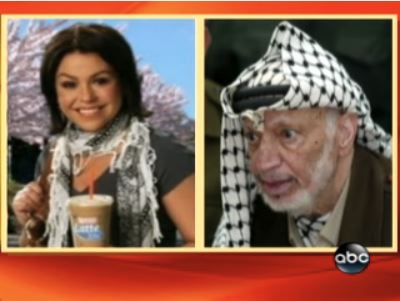 so recently, people have been making a big deal about the dunkin donut's ad featuring Rachael Ray in a scarf that looks similar to the traditional middle eastern garment known as a keffiyeh. To those unfamiliar with what it is, as Michelle Malkin would note, " as the traditional scarf of Arab men that has come to symbolize murderous Palestinian jihad. Popularized by Yasser Arafat and a regular adornment of Muslim terrorists appearing in beheading and hostage-taking videos, the apparel has been mainstreamed by both ignorant (and not so ignorant) fashion designers, celebrities and left-wing icons.”
Basically the ad has been pulled out because Dunkin Donuts does not want Rachael Ray fans to think they or she is a "terrorist sympathizer."
Honestly, pop culture has commodified so many symbolic things that it's outrageous that we're making a big thing about this now. Why are we trying to make a big deal out of Rachael Ray's wearing of a scarf mistakable for a keffiyeh because we're so quick to condemn these Palestinean jihads yet aren't we Americans as tax payers being supporters of Palestinean genocide by the Israeli's? How hypocritical can we be? Why are we so quick to condemn others? I'm not just pointing fingers at these right-wingers making a big deal out of this, I'm almost angry at the fashionistas profitting from the exploitation of a symbolic garment. Urban Outfitters is guilty of this and so are other high end brands, but us as consumers should also take responsibility in knowing the history of things we wear. Just because it is cool does not mean it does not mean anything to someone else in another part of the world.
This guy sums it up pretty well, we need to stop ignorantly commodifying other people's cultures. If you're gonna buy it and wear it, at least educate yourself on its significance. Its the least you can do.
Mumia Abu-Jamal -- Learning from Latin America!
One of the most famous political prisoners...From death row:
ISRAELI MINISTER SAYS ALTERNATIVES TO ATTACK ON IRAN RUNNING OUT:

An Israeli deputy prime minister on Friday warned that Iran would face attack if it pursues what he said was its nuclear weapons programme.
"If Iran continues its nuclear weapons programme, we will attack it," said Shaul Mofaz, who is also transportation minister.
"Other options are disappearing. The sanctions are not effective. There will be no alternative but to attack Iran in order to stop the Iranian nuclear programme," Mofaz told the Yediot Aharonot daily.
He stressed such an operation could only be conducted with US support.
A former defence minister and armed forces chief of staff, Mofaz hopes to replace embattled Ehud Olmert as prime minister and at the helm of the Kadima party.
http://news.yahoo.com/s/afp/20080606/wl_afp/mideastisraelirannuclear_080606121256
How many times U.S interfered militarily in Latin America?
I'm using the Easy share that youtube provides a link to under all of their videos!.... I saw this and it shocked me..ENJOY!
LIfe and Debt

REFLECTIONS OF FIDEL: The empire’s hypocritical politics
http://www.granma.cu/ingles/2008/mayo/lun26/Reflections-26may.html
IT would be dishonest of me to remain silent after hearing the speech Obama delivered on the afternoon of May 23 at the Cuban American National Foundation created by Ronald Reagan. I listened to his speech, as I did McCain’s and Bush’s. I feel no resentment towards him, for he is not responsible for the crimes perpetrated against Cuba and humanity. Were I to defend him, I would do his adversaries an enormous favor. I have therefore no reservations about criticizing him and about expressing my points of view on his words frankly.
What were Obama’s statements?
"Throughout my entire life, there has been injustice and repression in Cuba. Never, in my lifetime, have the people of Cuba known freedom. Never, in the lives of two generations of Cubans, have the people of Cuba known democracy. (…) This is the terrible and tragic status quo that we have known for half a century – of elections that are anything but free or fair (…) I won't stand for this injustice, you won't stand for this injustice, and together we will stand up for freedom in Cuba," he told annexationists, adding: "It's time to let Cuban American money make their families less dependent upon the Castro regime. (…) I will maintain the embargo."
The content of these declarations by this strong candidate to the U.S. presidency spares me the work of having to explain the reason for this reflection.
José Hernandez, one of the Cuban American National Foundation directors whom Obama praises in his speech, was none other than the owner of the Caliber-50 automatic rifle, equipped with telescopic and infrared sights, which was confiscated, by chance, along with other deadly weapons while being transported by sea to Venezuela, where the Foundation had planned to assassinate the writer of these lines at an international meeting on Margarita, in the Venezuelan state of Nueva Esparta.
Pepe Hernández’ group wanted to return to the pact with Clinton, betrayed by Mas Canosa’s clan, who secured Bush’s electoral victory in 2000 through fraud, because the latter had promised to assassinate Castro, something they all happily embraced. These are the kinds of political tricks inherent to the United States’ decadent and contradictory system.
Presidential candidate Obama’s speech may be formulated as follows: hunger for the nation, remittances as charitable hand-outs and visits to Cuba as propaganda for consumerism and the unsustainable way of life behind it.
How does he plan to address the extremely serious problem of the food crisis? The world’s grains must be distributed among human beings, pets and fish, the latter of which are getting smaller every year and more scarce in the seas that have been over-exploited by large trawlers which no international organization has been able to halt. Producing meat from gas and oil is no easy feat. Even Obama overestimates technology’s potential in the fight against climate change, though he is more conscious of the risks and the limited margin of time than Bush. He could seek the advice of Gore, who is also a democrat and is no longer a candidate, as he is aware of the accelerated pace at which global warming is advancing. His close political rival Bill Clinton, who is not running for the presidency, an expert on extra-territorial laws like the Helms-Burton and Torricelli Acts, can advise him on an issue like the blockade, which he promised to lift and never did.
What did he say in his speech in Miami, this man who is doubtless, from the social and human points of view, the most progressive candidate to the U.S. presidency? "For two hundred years," he said, "the United States has made it clear that we won't stand for foreign intervention in our hemisphere. But every day, all across the Americas, there is a different kind of struggle --not against foreign armies, but against the deadly threat of hunger and thirst, disease and
despair. That is not a future that we have to accept --not for the child in
Port au Prince or the family in the highlands of Peru. We can do better. We
must do better. (…) We cannot ignore suffering to our south, nor stand for the globalization of the empty stomach." A magnificent description of imperialist globalization: the globalization of empty stomachs! We ought to thank him for it. But, 200 years ago, Bolivar fought for Latin American unity and, more than 100 years ago, Martí gave his life in the struggle against the annexation of Cuba by the United States. What is the difference between what Monroe proclaimed and what Obama proclaims and resuscitates in his speech two centuries later?
"I will reinstate a Special Envoy for the Americas in my White House who will work with my full support. But we'll also expand the Foreign Service, and open more consulates in the neglected regions of the Americas. We'll expand the Peace Corps, and ask more young Americans to go abroad to deepen the trust and the ties among our people," he said near the end, adding: "Together, we can choose the future over the past." A beautiful phrase, for it attests to the idea, or at least the fear, that history makes figures what they are and not all the way around.
Today, the United States has nothing of the spirit behind the Philadelphia declaration of principles formulated by the 13 colonies that rebelled against English colonialism. Today, they are a gigantic empire undreamed of by the country’s founders at the time. Nothing, however, was to change for the natives and the slaves. The former were exterminated as the nation expanded; the latter continued to be auctioned at the marketplace —men, women and children—for nearly a century, despite the fact that "all men are born free and equal", as the Declaration of Independence affirms. The world’s objective conditions favored the development of that system.
In his speech, Obama portrays the Cuban Revolution as anti-democratic and lacking in respect for freedom and human rights. It is the exact same argument which, almost without exception, U.S. administrations have used again and again to justify their crimes against our country. The blockade, in and of itself, is an act of genocide. I don’t want to see U.S. children inculcated with those shameful values.
An armed revolution in our country might not have been needed without the military interventions, Platt Amendment and economic colonialism visited upon Cuba.
The Revolution was the result of imperial domination. We cannot be accused of having imposed it upon the country. The true changes could have and ought to have been brought about in the United States. Its own workers, more than a century ago, voiced the demand for an eight-hour work shift, which stemmed from the development of productive forces.
The first thing the leaders of the Cuban Revolution learned from Martí was to believe in and act on behalf of an organization founded for the purposes of bringing about a revolution. We were always bound by previous forms of power and, following the institutionalization of this organization, we were elected by more than 90% of voters, as has become customary in Cuba, a process which does not in the least resemble the ridiculous levels of electoral participation which, many a time, as in the case of the United States, stay short of 50% of voters. No small and blockaded country like ours would have been able to hold its ground for so long on the basis of ambition, vanity, deceit or the abuse of power, the kind of power its neighbor has. To state otherwise is an insult to the intelligence of our heroic people.
I am not questioning Obama’s great intelligence, his debating skills or his work ethic. He is a talented orator and is ahead of his rivals in the electoral race. I feel sympathy for his wife and little girls, who accompany him and give him encouragement every Tuesday. It is indeed a touching human spectacle. Nevertheless, I am obliged to raise a number of delicate questions. I do not expect answers; I wish only to raise them for the record.
Is it right for the president of the United States to order the assassination of any one person in the world, whatever the pretext may be?
Is it ethical for the president of the United States to order the torture of other human beings?
Should state terrorism be used by a country as powerful as the United States as an instrument to bring about peace on the planet?
Is an Adjustment Act, applied as punishment to only one country, Cuba, in order to destabilize it, good and honorable, even when it costs innocent children and mothers their lives? If it is good, why is this right not automatically granted to Haitians, Dominicans, and other peoples of the Caribbean, and why isn’t the same Act applied to Mexicans and people from Central and South America, who die like flies against the Mexican border wall or in the waters of the Atlantic and the Pacific?
Can the United States do without immigrants, who grow vegetables, fruits, almonds and other delicacies for U.S. citizens? Who would sweep their streets, work as servants in their homes or do the worst and lowest-paid jobs?
Are crackdowns on illegal residents fair, even as they affect children born in the United States?
Are the brain-drain and the continuous theft of the best scientific and intellectual minds in poor countries moral and justifiable?
You state, as I pointed out at the beginning of this reflection, that your country had long ago warned European powers that it would not tolerate any intervention in the hemisphere, reiterating that this right be respected while demanding the right to intervene anywhere in the world with the aid of hundreds of military bases and naval, aerial and spatial forces distributed across the planet. I ask: is that the way in which the United States expresses its respect for freedom, democracy and human rights?
Is it fair to stage pre-emptive attacks on sixty or more dark corners of the world, as Bush calls them, whatever the pretext may be?
Is it honorable and sane to invest millions and millions of dollars in the military industrial complex, to produce weapons that can destroy life on earth several times over?
Before judging our country, you should know that Cuba, with its education, health, sports, culture and sciences programs, implemented not only in its own territory but also in other poor countries around the world, and the blood that has been shed in acts of solidarity towards other peoples, in spite of the economic and financial blockade and the aggression of your powerful country, is proof that much can be done with very little. Not even our closest ally, the Soviet Union, was able to achieve what we have.
The only form of cooperation the United States can offer other nations consist in the sending of military professionals to those countries. It cannot offer anything else, for it lacks a sufficient number of people willing to sacrifice themselves for others and offer substantial aid to a country in need (though Cuba has known and relied on the cooperation of excellent U.S. doctors). They are not to blame for this, for society does not inculcate such values in them on a massive scale.
We have never subordinated cooperation with other countries to ideological requirements. We offered the United States our help when Hurricane Katrina lashed the city of New Orleans. Our internationalist medical brigade bears the glorious name of Henry Reeve, a young man, born in the United States, who fought and died for Cuba’s sovereignty in our first war of independence.
Our Revolution can mobilize tens of thousands of doctors and health technicians. It can mobilize an equally vast number of teachers and citizens, who are willing to travel to any corner of the world to fulfill any noble purpose, not to usurp people’s rights or take possession of raw materials.
The good will and determination of people constitute limitless resources that cannot be kept and would not fit in the vault of a bank. They cannot spring from the hypocritical politics of an empire.
Fidel Castro Ruz
May 25, 2008
10:35 p.m.
Translated by ESTI
IT would be dishonest of me to remain silent after hearing the speech Obama delivered on the afternoon of May 23 at the Cuban American National Foundation created by Ronald Reagan. I listened to his speech, as I did McCain’s and Bush’s. I feel no resentment towards him, for he is not responsible for the crimes perpetrated against Cuba and humanity. Were I to defend him, I would do his adversaries an enormous favor. I have therefore no reservations about criticizing him and about expressing my points of view on his words frankly.
What were Obama’s statements?
"Throughout my entire life, there has been injustice and repression in Cuba. Never, in my lifetime, have the people of Cuba known freedom. Never, in the lives of two generations of Cubans, have the people of Cuba known democracy. (…) This is the terrible and tragic status quo that we have known for half a century – of elections that are anything but free or fair (…) I won't stand for this injustice, you won't stand for this injustice, and together we will stand up for freedom in Cuba," he told annexationists, adding: "It's time to let Cuban American money make their families less dependent upon the Castro regime. (…) I will maintain the embargo."
The content of these declarations by this strong candidate to the U.S. presidency spares me the work of having to explain the reason for this reflection.
José Hernandez, one of the Cuban American National Foundation directors whom Obama praises in his speech, was none other than the owner of the Caliber-50 automatic rifle, equipped with telescopic and infrared sights, which was confiscated, by chance, along with other deadly weapons while being transported by sea to Venezuela, where the Foundation had planned to assassinate the writer of these lines at an international meeting on Margarita, in the Venezuelan state of Nueva Esparta.
Pepe Hernández’ group wanted to return to the pact with Clinton, betrayed by Mas Canosa’s clan, who secured Bush’s electoral victory in 2000 through fraud, because the latter had promised to assassinate Castro, something they all happily embraced. These are the kinds of political tricks inherent to the United States’ decadent and contradictory system.
Presidential candidate Obama’s speech may be formulated as follows: hunger for the nation, remittances as charitable hand-outs and visits to Cuba as propaganda for consumerism and the unsustainable way of life behind it.
How does he plan to address the extremely serious problem of the food crisis? The world’s grains must be distributed among human beings, pets and fish, the latter of which are getting smaller every year and more scarce in the seas that have been over-exploited by large trawlers which no international organization has been able to halt. Producing meat from gas and oil is no easy feat. Even Obama overestimates technology’s potential in the fight against climate change, though he is more conscious of the risks and the limited margin of time than Bush. He could seek the advice of Gore, who is also a democrat and is no longer a candidate, as he is aware of the accelerated pace at which global warming is advancing. His close political rival Bill Clinton, who is not running for the presidency, an expert on extra-territorial laws like the Helms-Burton and Torricelli Acts, can advise him on an issue like the blockade, which he promised to lift and never did.
What did he say in his speech in Miami, this man who is doubtless, from the social and human points of view, the most progressive candidate to the U.S. presidency? "For two hundred years," he said, "the United States has made it clear that we won't stand for foreign intervention in our hemisphere. But every day, all across the Americas, there is a different kind of struggle --not against foreign armies, but against the deadly threat of hunger and thirst, disease and
despair. That is not a future that we have to accept --not for the child in
Port au Prince or the family in the highlands of Peru. We can do better. We
must do better. (…) We cannot ignore suffering to our south, nor stand for the globalization of the empty stomach." A magnificent description of imperialist globalization: the globalization of empty stomachs! We ought to thank him for it. But, 200 years ago, Bolivar fought for Latin American unity and, more than 100 years ago, Martí gave his life in the struggle against the annexation of Cuba by the United States. What is the difference between what Monroe proclaimed and what Obama proclaims and resuscitates in his speech two centuries later?
"I will reinstate a Special Envoy for the Americas in my White House who will work with my full support. But we'll also expand the Foreign Service, and open more consulates in the neglected regions of the Americas. We'll expand the Peace Corps, and ask more young Americans to go abroad to deepen the trust and the ties among our people," he said near the end, adding: "Together, we can choose the future over the past." A beautiful phrase, for it attests to the idea, or at least the fear, that history makes figures what they are and not all the way around.
Today, the United States has nothing of the spirit behind the Philadelphia declaration of principles formulated by the 13 colonies that rebelled against English colonialism. Today, they are a gigantic empire undreamed of by the country’s founders at the time. Nothing, however, was to change for the natives and the slaves. The former were exterminated as the nation expanded; the latter continued to be auctioned at the marketplace —men, women and children—for nearly a century, despite the fact that "all men are born free and equal", as the Declaration of Independence affirms. The world’s objective conditions favored the development of that system.
In his speech, Obama portrays the Cuban Revolution as anti-democratic and lacking in respect for freedom and human rights. It is the exact same argument which, almost without exception, U.S. administrations have used again and again to justify their crimes against our country. The blockade, in and of itself, is an act of genocide. I don’t want to see U.S. children inculcated with those shameful values.
An armed revolution in our country might not have been needed without the military interventions, Platt Amendment and economic colonialism visited upon Cuba.
The Revolution was the result of imperial domination. We cannot be accused of having imposed it upon the country. The true changes could have and ought to have been brought about in the United States. Its own workers, more than a century ago, voiced the demand for an eight-hour work shift, which stemmed from the development of productive forces.
The first thing the leaders of the Cuban Revolution learned from Martí was to believe in and act on behalf of an organization founded for the purposes of bringing about a revolution. We were always bound by previous forms of power and, following the institutionalization of this organization, we were elected by more than 90% of voters, as has become customary in Cuba, a process which does not in the least resemble the ridiculous levels of electoral participation which, many a time, as in the case of the United States, stay short of 50% of voters. No small and blockaded country like ours would have been able to hold its ground for so long on the basis of ambition, vanity, deceit or the abuse of power, the kind of power its neighbor has. To state otherwise is an insult to the intelligence of our heroic people.
I am not questioning Obama’s great intelligence, his debating skills or his work ethic. He is a talented orator and is ahead of his rivals in the electoral race. I feel sympathy for his wife and little girls, who accompany him and give him encouragement every Tuesday. It is indeed a touching human spectacle. Nevertheless, I am obliged to raise a number of delicate questions. I do not expect answers; I wish only to raise them for the record.
Is it right for the president of the United States to order the assassination of any one person in the world, whatever the pretext may be?
Is it ethical for the president of the United States to order the torture of other human beings?
Should state terrorism be used by a country as powerful as the United States as an instrument to bring about peace on the planet?
Is an Adjustment Act, applied as punishment to only one country, Cuba, in order to destabilize it, good and honorable, even when it costs innocent children and mothers their lives? If it is good, why is this right not automatically granted to Haitians, Dominicans, and other peoples of the Caribbean, and why isn’t the same Act applied to Mexicans and people from Central and South America, who die like flies against the Mexican border wall or in the waters of the Atlantic and the Pacific?
Can the United States do without immigrants, who grow vegetables, fruits, almonds and other delicacies for U.S. citizens? Who would sweep their streets, work as servants in their homes or do the worst and lowest-paid jobs?
Are crackdowns on illegal residents fair, even as they affect children born in the United States?
Are the brain-drain and the continuous theft of the best scientific and intellectual minds in poor countries moral and justifiable?
You state, as I pointed out at the beginning of this reflection, that your country had long ago warned European powers that it would not tolerate any intervention in the hemisphere, reiterating that this right be respected while demanding the right to intervene anywhere in the world with the aid of hundreds of military bases and naval, aerial and spatial forces distributed across the planet. I ask: is that the way in which the United States expresses its respect for freedom, democracy and human rights?
Is it fair to stage pre-emptive attacks on sixty or more dark corners of the world, as Bush calls them, whatever the pretext may be?
Is it honorable and sane to invest millions and millions of dollars in the military industrial complex, to produce weapons that can destroy life on earth several times over?
Before judging our country, you should know that Cuba, with its education, health, sports, culture and sciences programs, implemented not only in its own territory but also in other poor countries around the world, and the blood that has been shed in acts of solidarity towards other peoples, in spite of the economic and financial blockade and the aggression of your powerful country, is proof that much can be done with very little. Not even our closest ally, the Soviet Union, was able to achieve what we have.
The only form of cooperation the United States can offer other nations consist in the sending of military professionals to those countries. It cannot offer anything else, for it lacks a sufficient number of people willing to sacrifice themselves for others and offer substantial aid to a country in need (though Cuba has known and relied on the cooperation of excellent U.S. doctors). They are not to blame for this, for society does not inculcate such values in them on a massive scale.
We have never subordinated cooperation with other countries to ideological requirements. We offered the United States our help when Hurricane Katrina lashed the city of New Orleans. Our internationalist medical brigade bears the glorious name of Henry Reeve, a young man, born in the United States, who fought and died for Cuba’s sovereignty in our first war of independence.
Our Revolution can mobilize tens of thousands of doctors and health technicians. It can mobilize an equally vast number of teachers and citizens, who are willing to travel to any corner of the world to fulfill any noble purpose, not to usurp people’s rights or take possession of raw materials.
The good will and determination of people constitute limitless resources that cannot be kept and would not fit in the vault of a bank. They cannot spring from the hypocritical politics of an empire.
Fidel Castro Ruz
May 25, 2008
10:35 p.m.
Translated by ESTI
Subscribe to:
Posts (Atom)