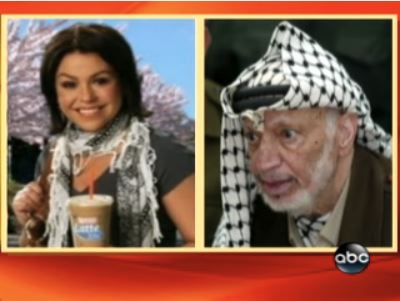
 so recently, people have been making a big deal about the dunkin donut's ad featuring Rachael Ray in a scarf that looks similar to the traditional middle eastern garment known as a keffiyeh. To those unfamiliar with what it is, as Michelle Malkin would note, " as the traditional scarf of Arab men that has come to symbolize murderous Palestinian jihad. Popularized by Yasser Arafat and a regular adornment of Muslim terrorists appearing in beheading and hostage-taking videos, the apparel has been mainstreamed by both ignorant (and not so ignorant) fashion designers, celebrities and left-wing icons.”
Basically the ad has been pulled out because Dunkin Donuts does not want Rachael Ray fans to think they or she is a "terrorist sympathizer."
Honestly, pop culture has commodified so many symbolic things that it's outrageous that we're making a big thing about this now. Why are we trying to make a big deal out of Rachael Ray's wearing of a scarf mistakable for a keffiyeh because we're so quick to condemn these Palestinean jihads yet aren't we Americans as tax payers being supporters of Palestinean genocide by the Israeli's? How hypocritical can we be? Why are we so quick to condemn others? I'm not just pointing fingers at these right-wingers making a big deal out of this, I'm almost angry at the fashionistas profitting from the exploitation of a symbolic garment. Urban Outfitters is guilty of this and so are other high end brands, but us as consumers should also take responsibility in knowing the history of things we wear. Just because it is cool does not mean it does not mean anything to someone else in another part of the world.
This guy sums it up pretty well, we need to stop ignorantly commodifying other people's cultures. If you're gonna buy it and wear it, at least educate yourself on its significance. Its the least you can do.

3 comments:
My dear Satypuja,
I imagine there are pros and cons about wearing a keffiyyeh scarf. On the one hand it can symbolize the struggle of the Palestinians, for example. In this case the message should go along with the marketing of the product, and then I can assure you that it would lose popularity among its influx into popular culture. On the other hand, one can view it as exploitation of an important cultural symbol. I spoke with Natives from Oaxaca recently at the University of California (Riverside) campus recently who were very angry that Chinese companies have been coming in and studying the cultural weavings of the Oaxaca indigenous community and replicating them en masse and then selling them on the US/Mexico border as well as around the towns of Oaxaca.
So where do we as consumers draw the line? I certainly don't want to wear a mass produced replica of a cultural symbol that steals the livelihood of a dirt poor indigenous woman who's rice and beans depend on such sales of true hand made authentic treasures.
Nay, if I were to wear this new fashionista fad of the keffiyyeh you had better believe its going to be a real palestinian keffiyyeh worn with meaning and symbolic representation against the oppression of those people. Within this context I believe its quite ok to do in solidarity with the opposed people, and quite beautiful a garment, when authentically made.
As for Rachel Ray, so she's wearing one on TV so what! You see the racism on television, having affiliated it with the bedouin scarf and then subsequently pulling the ad off the air is pure racism and censorship. Perhaps she was sending a statement of solidarity; perhaps the whole trend is in fact saying that we havent forgotten the children of Shatila and others. The only problem now that we should examine is, who is profiting from such en masse marketing. Personally, i would accept an authentic keffiyyeh over a replica made in China, because of the signifigance
yea, the whole ad was blown out of proportion, its ridiculous. an interesting point an arab friend of mine pointed out was that he actually likes the popularity of the keffiyeh because in a sense it's normalizing arab culture into american culture, but its still sad nonetheless that it's a bunch of rich white folks or what not gaining profit from it instead of those who could really use the money.
I agree! It's normalizing and watering down a very powerful symbol of the palestinian resistance...And Danny you should become a writer....PEACE
Post a Comment